At nine in the morning the 2026-2027 Marketing cohort knew it had been admitted. By quarter to two it knew how the year is actually built, what it will have to choose and when, and who to ask when something goes wrong. That is the whole job of a kick-off, and it is the reason the day sits on the schedule as a course.
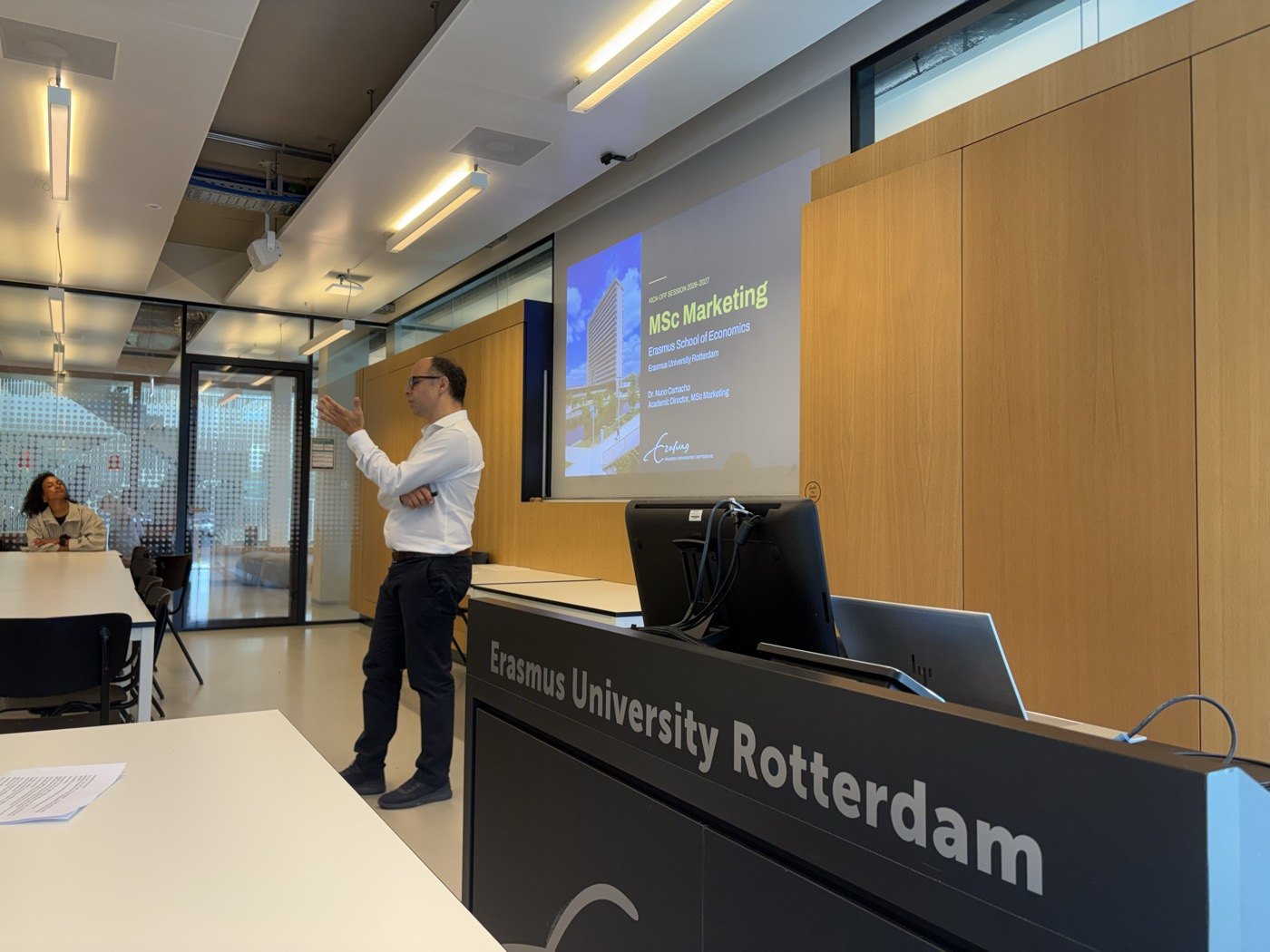
Take-Off runs 09:00 to 18:00 and stays faculty-wide until the specialisations split off into their own rooms. Marketing’s 45 minutes ran from 13:00, led by Nuno Camacho, associate professor of marketing at Erasmus School of Economics and academic director of the MSc Marketing.
What the cohort now knows about the year
The shape first, because you cannot infer it from a course list. Five blocks of eight weeks, seven of teaching and one for examinations, 60 credits in total. Block 1 is fixed and everybody takes the same three core courses of 4 credits, so the cohort spends its first seven weeks in one room. Block 2 pairs Marketing Analytics and Data Visualisation with electives. Block 3 is the 10-credit Seminar Strategic Marketing Leadership.
Two things in that structure surprise people, and both were worth the time they got. The thesis, 16 credits, runs underneath blocks 3 to 5 rather than waiting at the end, so it starts while courses are still running. And the degree is chosen twice, not once. Block 2 carries 8 credits of electives, either both marketing electives or one of them plus another Economics and Business master course. Block 4 is the bigger single decision: one 10-credit seminar out of three, Global Marketing, Designing New Products and Experiences or Customer-centric Value Creation. Those three point in genuinely different directions, towards international strategy, towards innovation, and towards the economics of keeping the customers you already have.
Eighteen of the 44 taught credits are chosen, not assigned.
And what the programme expects back
Camacho’s own research builds econometric models of consumer decisions, mostly around the marketing of innovations and the life sciences industry. Marketing at an economics faculty is treated as something you measure rather than something you assert, which is why block 1 puts a research-design course next to a branding one and grades both partly on group work.
The faculty-wide morning covers the unglamorous half: the four systems that run a Dutch master. Canvas carries course materials, assignments and announcements. Osiris holds enrolment, grades and study progress. MyEUR reaches the study advisers. MyTimetable is the schedule, set per block rather than fixed for the year. Two habits are worth keeping: leave Canvas notifications on, because course information is published there and missing it counts as your problem, and register for every exam through the portal up to a week beforehand, because an unregistered exam is one whose grade goes unrecorded however well you sat it.
Then the association gets the room
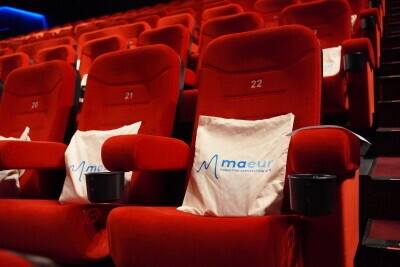
The last stretch was not the programme’s. MAEUR, the Marketing Association EUR, is the official study association for three master programmes across two schools: Marketing Management at RSM, and Marketing and Data Science & Marketing Analytics at ESE. It was founded in the 1969-70 academic year as the Marketing Genootschap, one year after the department it grew out of was installed, and it now has more than 1,200 members.
What it runs falls into two halves: learning, meaning events and workshops, and networking, meaning career days and drinks. Two dates are close enough to matter this week. The committee interest lunch on Friday 4 September 2026, which is how you get onto a committee rather than something to sit through, and Commercial Break on Thursday 10 September 2026. The office is room T06-08 in the Mandeville building.
It also hosted the drinks that closed the day, which is where most of the actual introducing gets done.
What the day is worth
Nothing that reaches a transcript. Take-Off Master is course code FEM61000 and carries zero credits, in the same block-1 column as the three courses that do count. What the 45 minutes buy is that the person running your programme, the two choices you will have to make and the association that will fill your calendar all turn up on the same afternoon, in a room where nobody has been graded yet and introducing yourself still costs nothing.
Block 1 starts the next morning: three courses, seven weeks, an exam week at the end of October. Good luck to the 2026-2027 cohort.
Learn more
Where do you actually get to choose?
Twice. In block 2 you take 8 credits of electives: either Digital Customer Engagement and Marketing and Sales Alignment, or one of those two plus another Economics and Business master course, with the core courses of the Data Science and Marketing Analytics specialisation ruled out. In block 4 you take one seminar of three, worth 10 credits. Global Marketing covers expanding internationally and building strategy across standardisation, local adaptation and what a firm learns from operating in several markets at once. Designing New Products and Experiences takes innovation as the thing most modern firms run on. Customer-centric Value Creation is about the long-run profitability of a customer and about using consumer data to manage that relationship. The course catalogue has the full descriptions and assessment.
How do you join MAEUR, and what is Commercial Break?
Membership goes through maeur.nl, and the upcoming events page is the calendar that counts, because dates move. Commercial Break is listed there for 10 September 2026. The committee interest lunch six days earlier is the entry point for anyone who would rather organise than attend, which is the version of a study association that ends up meaning something on a CV.
Read more
- Nuno Camacho’s staff profile at Erasmus University
- MAEUR’s upcoming events
- Take-Off for master students, on eur.nl
- The official study schedule: every block, every code, every credit
- Where the degree leads, and the rest of the structure
Sources and notes
A first-hand account of the MSc Marketing kick-off session held on Tuesday 1 September 2026, written from notes and photographs taken in the room between 13:00 and 13:45. The date, the 09:00 to 18:00 span of the faculty-wide day, and the 13:00 to 13:45 Marketing session with its room in Polak: Take-Off introduction for Master students, 1 September 2026, eur.nl. Nuno Camacho’s position as associate professor of marketing and his research interests are from his EUR staff profile; his title of academic director of the MSc Marketing was given in the session. The four university systems and what each is for, the instruction to leave Canvas notifications on, and the rule that an exam must be registered through the student portal up to a week beforehand or the grade is not recorded: the MSc Marketing kick-off material for 2026-2027, supported by Studying at Erasmus School of Economics on eur.nl. Blocks, codes, credits, the 0-credit FEM61000 and the three block 4 seminars: the official ESE study schedule for the MSc Economics and Business, specialisation Marketing, 2026-2027, cross-checked against the EUR course catalogue. The block 2 elective rule is quoted from that schedule: students take both listed courses, or one of them plus one other Economics and Business master course, excluding the core courses of the Data Science and Marketing Analytics specialisation. The 44 taught credits are the 60 total less the 16-credit thesis, and the 18 chosen credits are the 8 elective credits in block 2 plus the 10-credit block 4 seminar. That MAEUR hosted the drinks after Take-Off is a first-hand observation. Group work in block 1 is described in our own account of the block. MAEUR’s founding in the 1969-70 academic year as the Marketing Genootschap and its membership of more than 1,200: the MAEUR history page. The dates of 4 and 10 September 2026, the event names and the office address: MAEUR’s upcoming events page and maeur.nl, read on 1 September 2026. Deliberately not claimed here: the names of the three academics who teach the block 4 seminars, and the name of the MAEUR board member who presented. Photograph of the kick-off room by the author; the board photograph is MAEUR’s, from maeur.nl, used with the association’s permission. Dates and rooms change; the official pages are the version that counts.
Hero photograph. Photo: MSc Marketing, 1 September 2026.